

Three works of Angelika Hoerle
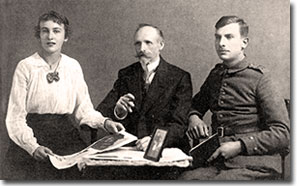
Photo of Angelika Fick with father Richard Fick Sr and Willy Fick taken around 1916 Q & A Anton Raderscheidt’s Wives I came across your website while researching a couple of prints I have inherited signed 'Gisele Raderscheldt'. The prints are stamped 'Nachlass Anton Raderscheldt'. However, I can't seem to find anything on 'Gisele'. Have you ever come across this name in your art research? Rebecca Russell, New Zealand Anton Raderscheidt and his first wife, the artist Marta Hegemann, were about the best friends anyone could have. When their friend Angelika Fick Hoerle became ill with tuberculosis and her husband Heinrich and ‘friends’ deserted her, Anton and Marta stayed by her side. Life being what it is, fraught with triumphs and tragedies, Angelika died at 23 years of age and Anton left Marta and children behind. Anton left with Ilse Salberg, a well-to-do Jewish married art patron. During the Nazi era, Anton experienced great difficulties because of Ilse’s Jewish heritage. However, with luck, friends and connections, he eluded death. Ilse, an accomplished photographer, died shortly thereafter of cancer. Anton's third wife and mother to more of his children (he had had two with Marta) was Gisele Ribreau who he met in 1948. The website www.raederscheidt.com doesn't say when they married. As Anton had a stroke in 1967 and to the best of my knowledge, Gisele was not an artist, I'm guessing that she signed some of his late works between 1967-70. You'd have to describe the subject matter of the works to try to pinpoint the decade in which they originated. The good news is that I have some connections with Anton’s first family (Marta Hegemann’s son Johannes is still alive and very ‘peppy’ at 89 years of age) and the grand-daughter MAF Raederscheidt, a fantastic artist in her own right, who makes videos on artists for the "Rheingalerie" at www.center.tv (with her partner Stephan Everling). I will ask her for more information about Gisele. My hunch is that you’ve lucked into some Anton Raederscheidt works. Horse and Rider Still Life Aquarell Still Life Linocut https://en.wikipedia.org/wiki/Angelika_Hoerle |
Angelika (Fick) Hoerle • 1899 ~ 1923
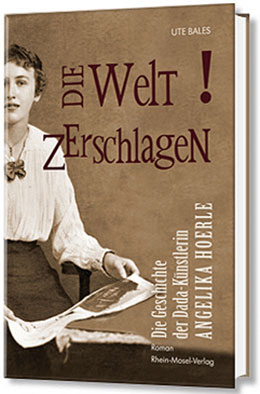
German author Ute Bales published her novel about my great-aunt Angelika Die Welt Zerschlagen: die Geshichte der Dada-Kuenstlerin Angelika Hoerle, with Rhein-Mosel Verlag early in 2016. After a full year of interacting with Ute during her research and writing, I was delighted to introduce her reading in Simonskall on April 17, 2016. Ute read to a full house in the Marienkapelle in the Eifel Mountains south of Cologne—a place where Angelika Hoerle honeymooned in June 1919. During the reading Ute played a piece of music specially composed for her book tour by Canadian composer Ennio Paola. The hushed audience was awe-inspired as The World is Smashed echoed in the beautiful chapel. Mary Cook and Andrea Ketelaars consulted on the book`s cover—a German-Canadian co-operative venture.
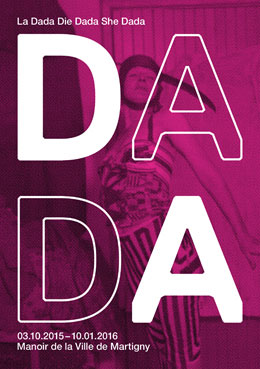
Vernissage Pour fêter ce jubilé, le Manoir de la Ville de Martigny propose LA DADA DIE DADA SHE DADA, une exposition en partenariat avec le Forum Schlossplatz Aarau et le Kunstmuseum d’Appenzell. Cinq femmes dadaïstes actives à Paris, New York, Berlin, Cologne et Zurich sont présentées à travers une série d’œuvres et de documents : l’écrivaine Céline Arnauld, la peintre et graphiste Angelika Hoerle, la collagiste Hannah Höch, la performeuse Elsa von Freytag-Loringhoven et la peintre et plasticienne Sophie Taeuber-Arp. L’exposition s’attache également à mettre en valeur la portée de cet héritage aujourd’hui à travers des créations inédites de cinq artistes vidéastes contemporaines animées par l’esprit de ces grandes femmes de l’histoire de l’art : Judith Albert, Elodie Pong, Anne-Julie Raccoursier, Chantal Romani et Anka Schmid. Le Manoir de la Ville de Martigny Angelika Hoerle ~ closed exhibition at Museum Ludwig
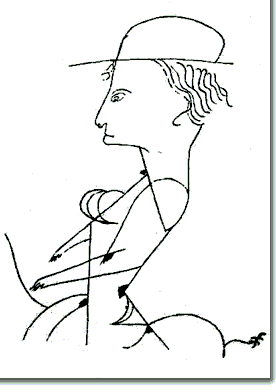
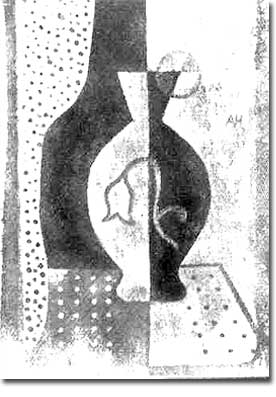
Where are the originals? These Angelika Hoerle works were reproduced in Bulletin D, Stupid 1 and Die Schammade, but where are the originals? Help us to find the originals for the 2009-2010 Art Gallery of Ontario Exhibition, titled Angelika Hoerle: Cologne Comet of Dada We know where almost all of her extant works are. Join the sleuthing to find the remainder. Angelika Hoerle's Gravesite Angelika Hoerle died of tuberculosis Sept 9, 1923. ~ read more
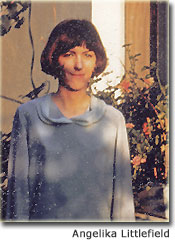
She was a compatriot of Max Ernst, wife of Heinrich Hoerle, friend to Marta Hegeman and Anton Raderscheidt, three of her works were purchased by Katherine Dreier to be memorialized in Yale’s Societe Anonyme Collection. She was dead of tuberculosis by 23 years of age. My great-aunt Angelika Fick Hoerle was a political activist whose art crossed styles and whose passion to make positive changes in society did not die with her. To prepare for an exhibition of her works at the Art Gallery of Ontario in 2009-2010 I am looking to find EVERYTHING THERE IS TO KNOW ABOUT HER. To do that, I’m willing to share what I know about her and Cologne dada. Join with me on the voyage of discovery. Photo above of young Angelika, me, at my uncle Willy Fick's atelier in Cologne. On a recent trip to Cologne I was fortunate enough to visit with the 89 year old Johannes Raederscheidt, whose father and mother were sheltering angels to my great-aunt Angelika Hoerle. In the early 1920s when Angelika’s husband Heinrich and fair weather friends abandonned Angelika because she had tuberculois, Marta and Anton Raederscheidt stuck by her. ~ read more Günther Limburg recently painted Angelika Hoerle with her husband Heinrich dominating the foreground. With what is known about Angelika, this is an apt portrayal. However, with the 2009 exhibition of Angelika's oeuvre at the Art Gallery of Ontario, she will finally emerge rightfully from behind his shadow. Günther Limburg is a successful German artist whose works may be seen at www.art-in-cologne-guenther-limburg.de Guenther's current exhibition "Spurren" or "Traces" is in the Junker Haus in the Eiffel mountains outside Cologne, a place Angelika and Hoerle visited as a type of honeymoon outing in June 1910. More about "Traces" later. In Günther's words: http://www.saatchi-gallery.co.uk/yourgallery/artist_profile/Guenter+Limburg/29596.html
|
|||

 Angelika Hoerle gets more of her due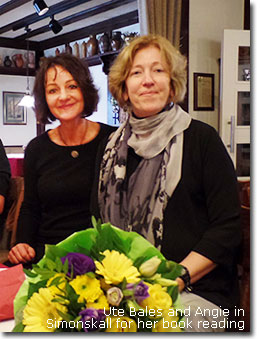

 Angelika Hoerle: Comet of Cologne Dada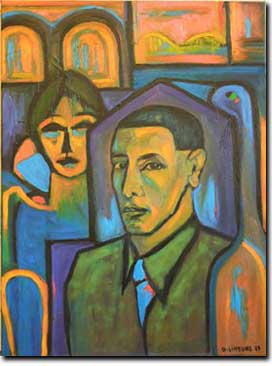
Angie Littlefield | 416.282.0646 | angie.littlefield@yahoo.ca